
Virtual Support Group: Special Needs Parent
Special Needs Parents Virtual Support Group
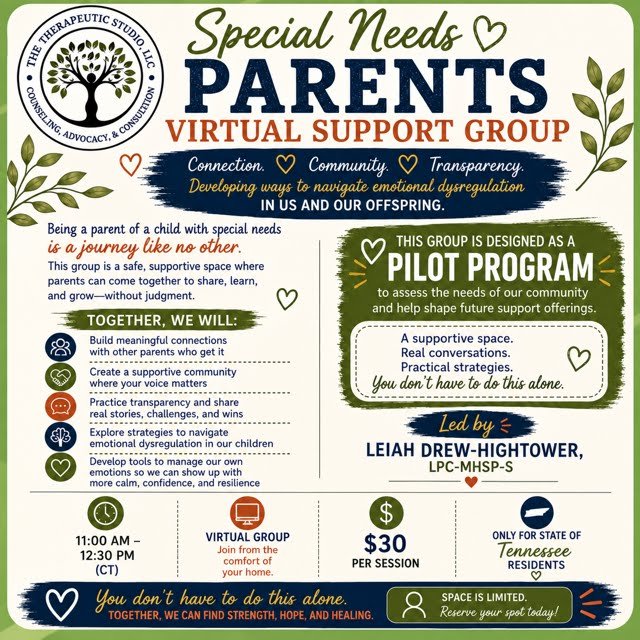
Join us for a seven-week pilot program offering connection, transparency, encouragement, and practical support for parents navigating the complexities of raising a child with special needs.
We will meet virtually on Mondays, beginning each gathering with a gentle regulation practice to help us slow down, settle our bodies, and become present.
Throughout the group, we will explore:
Cognitive Behavioral Therapy (CBT)
Dialectical Behavior Therapy (DBT)
Somatic Experiencing (SE)
Narrative Therapy—exploring and reshaping the stories we carry about ourselves, our children, and our parenting journeys
Sensory integration and regulation
Understanding our eight sensory systems, including interoception, proprioception, and the vestibular system
Practical tools for navigating emotional dysregulation
Strategies for strengthening coping, connection, and communication within the family
Our children and stories may look different, but we are navigating many of the same hopes, challenges, and unexpected turns. Together, we will connect, process, learn, and remember that we do not have to walk this road alone.
Begins Monday, September 14
Come as you are. Your story is welcome here.
Neurodivergent Adults: Community Connection Group
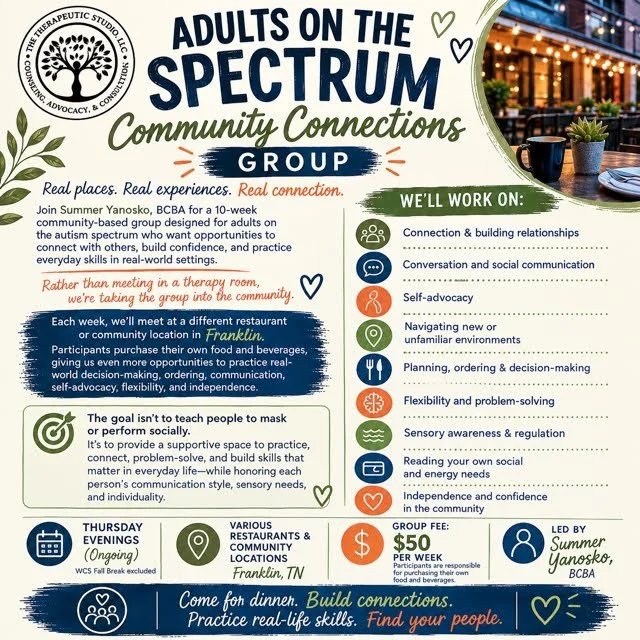
Because connection, independence, and confidence are built in the places where life actually happens. The Therapeutic Studio is excited to offer a weekly community-based group for neurodivergent adults, facilitated by our Board Certified Behavior Analyst (BCBA). Dinner in the Community Each week, our group will meet at a different community location for dinner, connection, and real-world skill building. Rather than practicing skills only in a therapy office, participants will have opportunities to build confidence while navigating everyday community experiences alongside peers.
Skills we may practice include:
• Ordering food and communicating with restaurant staff
• Reading menus and making choices
• Budgeting and understanding the cost of a meal
• Paying, tipping, and managing money
• Conversation and social connection
• Joining and maintaining group conversations
• Self-advocacy and communicating needs
• Navigating sensory needs in public spaces
• Recognizing when a break is needed
• Flexible thinking when plans change
• Waiting and managing downtime
• Problem-solving
• Community safety and awareness
• Building friendships and confidence
• Increasing independence in everyday life
Our goal isn’t to teach neurodivergent adults to “fit in.”
Our goal is to create an affirming space where adults can connect with peers, practice meaningful life skills, advocate for what they need, and become more confident navigating their community as themselves.
Please Note: Participants are responsible for purchasing their own food and beverages at each community outing.
Community locations will vary throughout the Franklin/Spring Hill area.
Come eat. Connect. Practice. Laugh. Build confidence. Find your people.
Hosted by The Therapeutic Studio, LLC
Counseling • Advocacy • Consultation • Autism Services • Community Support
Side Quest Club
A Low-Pressure Young Adult Connection Group
Sometimes being around people is enough.
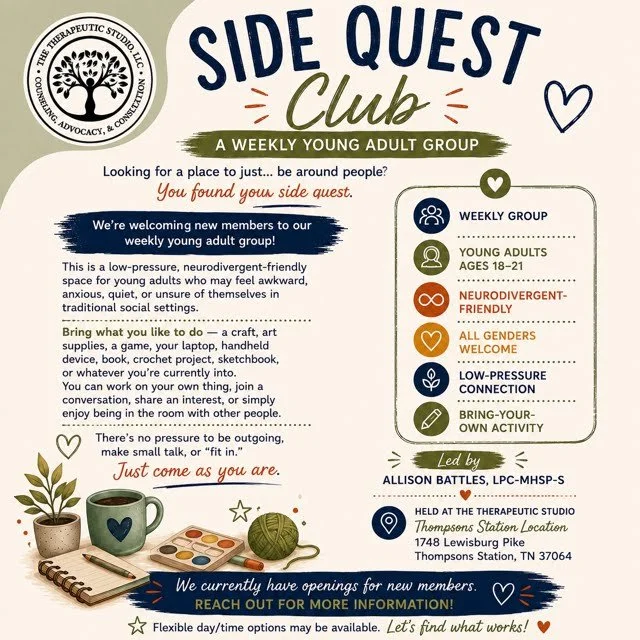
Side Quest Club is an ongoing weekly group for young adults ages 18–21 who want connection and community without the pressure that can come with traditional social settings.
Designed to be neurodivergent-friendly, interest-based, and low-pressure, Side Quest Club creates space for young adults who may feel anxious, awkward, quiet, unsure of themselves socially—or simply more comfortable connecting when the focus isn’t entirely on conversation.
There is no expectation to walk into the room and immediately socialize.
Instead, participants are invited to bring something they already enjoy doing: a craft, drawing supplies, crochet, a book, laptop, handheld gaming device, card or tabletop game, sketchbook, current project, or another favorite activity.
Work independently. Sit near someone. Join a game. Share an interest. Listen to a conversation. Start one if you want to.
Connection can happen without forcing it.
What Makes Side Quest Different?
Side Quest Club isn’t about teaching young adults how to appear more social or asking them to perform a particular version of “normal.”
It’s about creating the conditions where authentic connection has room to develop.
Within the group, participants have opportunities to practice things like:
Building and maintaining relationships
Initiating and joining conversations
Sharing interests with others
Navigating group dynamics
Reading and communicating boundaries
Self-advocacy
Flexibility and collaborative problem-solving
Emotional regulation in social situations
Becoming more comfortable being themselves around other people
And sometimes the most meaningful step is simply showing up and sharing space with other people.
That counts, too.
Who Is Side Quest Club For?
Side Quest Club may be a good fit for young adults who:
Want friendships or connection but aren’t sure where to find their people
Experience social anxiety or feel uncomfortable in traditional social environments
Are autistic, ADHD, otherwise neurodivergent, or simply connect differently
Prefer activity-based interaction over sitting in a circle and talking
Have strong interests they’d enjoy pursuing alongside other people
Want a consistent place to belong without pressure to “fit in”
All genders are welcome.
An Ongoing Group
Unlike our time-limited groups, Side Quest Club is ongoing, allowing relationships, familiarity, and a sense of community to develop over time.
We are currently welcoming new members.
Weekly | Ages 18–21
Led by Allison Battles, LPC-MHSP-S
The Therapeutic Studio – Thompson’s Station
1748 Lewisburg Pike
Thompson’s Station, TN 37064
Day and time options may be flexible depending on current group needs and enrollment.
Come As You Are.
You don’t need to have the right thing to say.
You don’t need to be outgoing.
You don’t need to make small talk.
Bring something you enjoy, find a comfortable spot, and see what happens when connection doesn’t have to be forced.
Contact The Therapeutic Studio to learn more about Side Quest Club, current openings, and whether the group may be a good fit.
Homeschool Support Group
Homeschooling gives kids flexibility—but that doesn’t mean navigating the day is always easy.
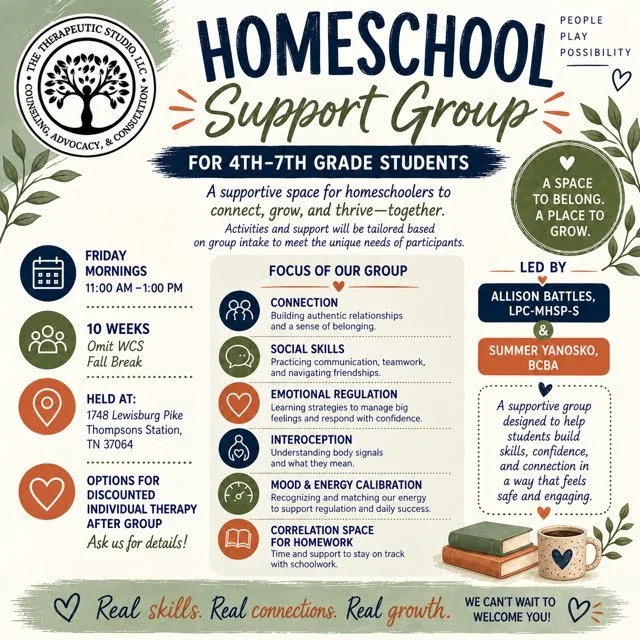
Our Homeschool Support Group for 4th–7th graders is a 10-week, small-group experience designed to support the skills underneath learning, relationships, and everyday functioning.
Led by Allison Battles, LPC-MHSP-S and Summer Yanosko, BCBA, the group brings together therapeutic and behavioral perspectives to help us understand the whole child—not simply whether an assignment gets completed.
We’ll explore and practice:
Executive Functioning
Planning, organization, task initiation, working memory, flexible thinking, transitions, time awareness, and figuring out how to get started when something feels overwhelming.
Sensory Profiles & Regulation
Helping kids notice how their individual sensory systems affect attention, energy, comfort, participation, and regulation—and discover practical strategies that work for their bodies and brains.
Interoception
Building awareness of internal body signals and learning to connect those signals with emotions, needs, energy, hunger, stress, and regulation.
Mood & Energy Calibration
Learning to recognize, communicate, and respond to different levels of energy and emotion—without expecting kids to be “calm” all the time.
Social Skills & Connection
Practicing communication, perspective-taking, collaboration, boundaries, problem-solving, friendship skills, and navigating the natural give-and-take of being with other people.
Homework & Independent Work
Dedicated space to apply these skills in real time. Rather than simply saying “focus” or “get organized,” we can help kids identify what is getting in the way and practice strategies that make learning more manageable.
The goal isn’t to make every child function the same way.
It’s to help each student better understand how they function—and build practical tools for learning, relationships, regulation, and increasing independence.
Fridays | 11:00 AM–1:00 PM
Beginning September 11 | 10 weeks
WCS Fall Break omitted
The Therapeutic Studio — Thompson’s Station
1748 Lewisburg Pike
Designed primarily for 4th–7th grade homeschoolers, with placement based on intake and group fit.
Discounted individual therapy options will also be available following group for families who would like additional individualized support. We
No Words Needed: An Art Therapy Group
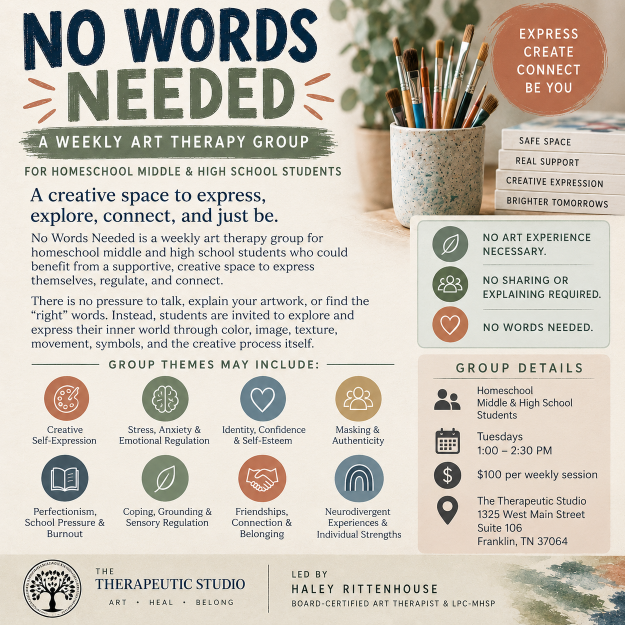
No Words Needed: An Art Therapy Group is led by Haley Rittenhouse, LPC-MHSP, ATR-BC, Board-Certified Art Therapist, and was created for children and teens who may have a lot going on internally but do not always want—or know how—to put those experiences into words.
Sometimes traditional conversation can feel like too much. A child may know they are feeling something without being able to name it, explain it, or talk about it directly. Other times, they may simply feel more comfortable expressing themselves through creativity than through conversation. This group gives participants permission to communicate in a different way.
Sometimes there’s a lot to express—and no desire, need, or easy way to put it into words.
No Words Needed is an art therapy group centered on nonverbal expression, creativity, regulation, and connection. There is no pressure to talk, explain artwork, participate verbally, or find the “right” words.
Using a variety of art therapy techniques and creative mediums, participants are invited to express and explore their inner world in ways that feel safe, natural, and authentic. This may include painting, drawing, collage, clay, mixed media, sensory-based art, movement, symbolism, texture, and other expressive experiences.
The focus is not on artistic ability or creating a “perfect” piece of art. Instead, the creative process becomes a pathway for exploring emotions, experiences, identity, relationships, stress, sensory needs, self-expression, regulation, and connection.
Participants can create alongside others in a quiet, supportive therapeutic environment where connection does not depend on conversation and where the artwork itself can become part of the communication.
The group is designed to honor different communication styles, personalities, sensory needs, and levels of comfort. A participant may want to create quietly beside someone else, communicate through artwork, observe before joining, or gradually interact with others through shared creative experiences. All of those ways of participating are welcome.
Because the group is facilitated by a licensed mental health therapist and board-certified art therapist, the creative process is intentionally supported through a therapeutic lens that considers emotional safety, regulation, development, communication, and each participant’s individual needs.
Group Details
Facilitator: Haley Rittenhouse, LPC-MHSP, ATR-BC
Cost: $100 per session
Location: The Therapeutic Studio
1325 West Main Street, Suite 106
Franklin, TN
No art experience is necessary.
No sharing or explaining is required.
No pressure to speak.
No words are needed.
For some children and teens, removing the expectation to talk can create more room for authentic expression, connection, confidence, emotional regulation, and self-discovery.
Come as you are. Make what you need to make. Let the art speak.
Lego Club
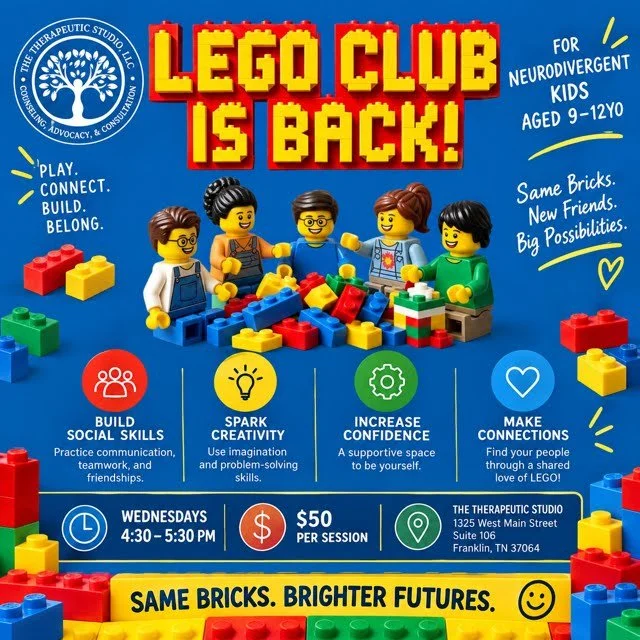
Why LEGO® Club? Building Social Skills One Brick at a Time
At The Therapeutic Studio, LEGO Club isn’t just about building something cool—although we definitely do that, too!
We use LEGO® building as a shared activity to create natural opportunities for children to practice important social and emotional skills. The approach is inspired by principles of LEGO®-Based Therapy, originally developed by Daniel B. LeGoff, which uses children’s interest in LEGO building to support communication, cooperation, and social connection.
How Does It Work?
Instead of sitting at a table and being told how to “have a conversation” or “work together,” children are given a meaningful reason to communicate.
They have something to build together.
During collaborative LEGO activities, children may take on different roles, such as:
Engineer — looks at the instructions and explains what is needed.
Supplier — finds the correct LEGO pieces and gives them to the builder.
Builder — listens to the directions and puts the pieces together.
The roles can rotate so that every child gets opportunities to practice different skills.
And this is where the social learning happens.
Children naturally have to practice:
Asking for what they need
Listening to another person’s ideas
Giving and following directions
Sharing materials
Taking turns
Joint attention
Perspective-taking
Waiting
Negotiating
Problem-solving
Handling mistakes
Managing frustration
Being flexible when plans change
Repairing misunderstandings
Celebrating another person’s ideas and successes
The LEGO Build Becomes the Social Classroom
Imagine two children both reaching for the same LEGO piece.
Instead of immediately solving the problem for them, the facilitator can help them notice what is happening and practice navigating it:
“You both need that piece. What could we do?”
Now we have an opportunity to practice negotiation, communication, flexibility, and emotional regulation—all within an activity the children are already motivated to participate in.
Or perhaps the structure falls apart.
That’s another opportunity.
We can practice noticing frustration, regulating our bodies, asking for help, tolerating imperfection, and trying again.
We Don’t Expect Social Skills to Look One Particular Way
Our goal is not to teach children to mask their neurodivergence or perform “typical” social behaviors.
We want children to develop authentic social competence.
That means learning:
How do I communicate what I need?
How do I understand what someone else might need?
What can we do when our ideas are different?
How can I stay connected while still being myself?
LEGO building gives us a concrete, visual, hands-on way to practice these skills.
From Structured Building to Creative Collaboration
As children become more comfortable, we can move beyond instruction-based builds and introduce collaborative challenges:
“Build a playground together.”
“Create a LEGO town where everyone needs a job.”
“Build something that represents an emotion.”
“You each have different pieces. How can you combine them to make one creation?”
“Build the tallest tower your team can make—but everyone must contribute.”
These activities introduce executive functioning, flexible thinking, emotional expression, leadership, compromise, creativity, and teamwork.
And perhaps most importantly, children get repeated experiences of:
I have ideas.
You have ideas.
Our ideas can be different.
And we can still build something together.
That is why we use LEGO Club to teach social skills.
We’re building much more than LEGO creations.
We’re building communication, confidence, flexibility, relationships, and connection—one brick at a time.
Tuesday Night Middle School Connection Group
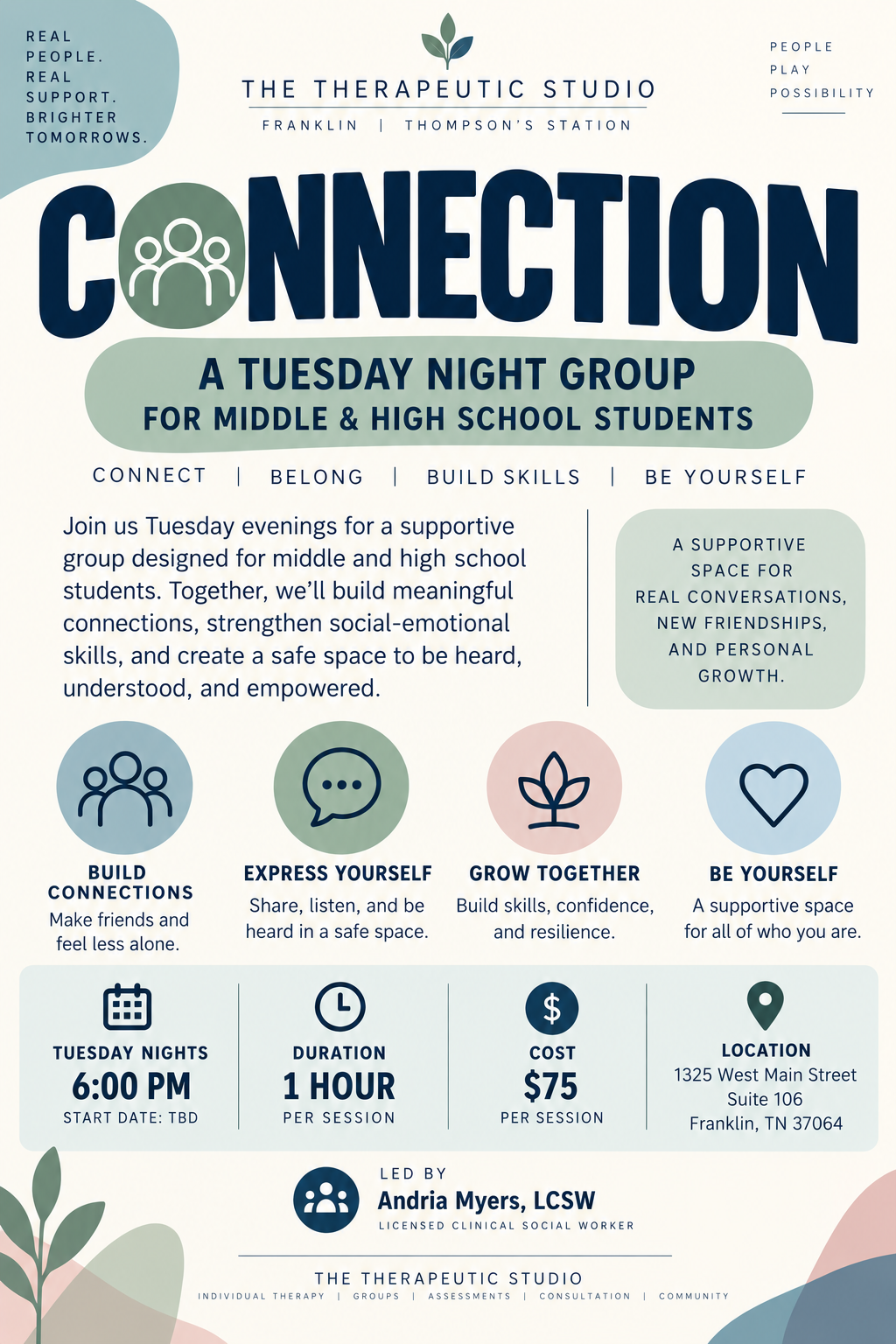
Middle school can be a season filled with change, social pressure, big emotions, and the growing need to understand yourself and where you fit. Our Tuesday Night Middle School Connection Group provides a supportive and welcoming space where students can connect with peers, strengthen emotional wellness, and build practical skills for navigating everyday life.
Led by Andria Jordan-Myers, LCSW, this group uses creative, engaging activities alongside evidence-based approaches such as Dialectical Behavior Therapy (DBT), Cognitive Behavioral Therapy (CBT), and other developmentally appropriate therapeutic interventions.
Through conversation, activities, and shared experiences, group members will have opportunities to strengthen:
Positive peer connection and healthy relationships
Emotional awareness and regulation
Coping skills for stress, anxiety, and overwhelm
Communication and self-advocacy
Confidence and self-esteem
Flexible thinking and problem-solving
Mindfulness and distress-tolerance skills
A greater sense of belonging and connection
This is not about asking middle schoolers to sit around and simply “talk about their feelings.” We want to create a space that feels engaging, authentic, and comfortable — where students can learn through creativity, connection, movement, discussion, and practical experiences.
Our goal is for each student to leave feeling seen, supported, connected, and better equipped to navigate the middle school years.
Tuesdays | 6:00 PM
Led by Andria Jordan-Myers, LCSW
The Therapeutic Studio
Tuesday Women’s Support Group
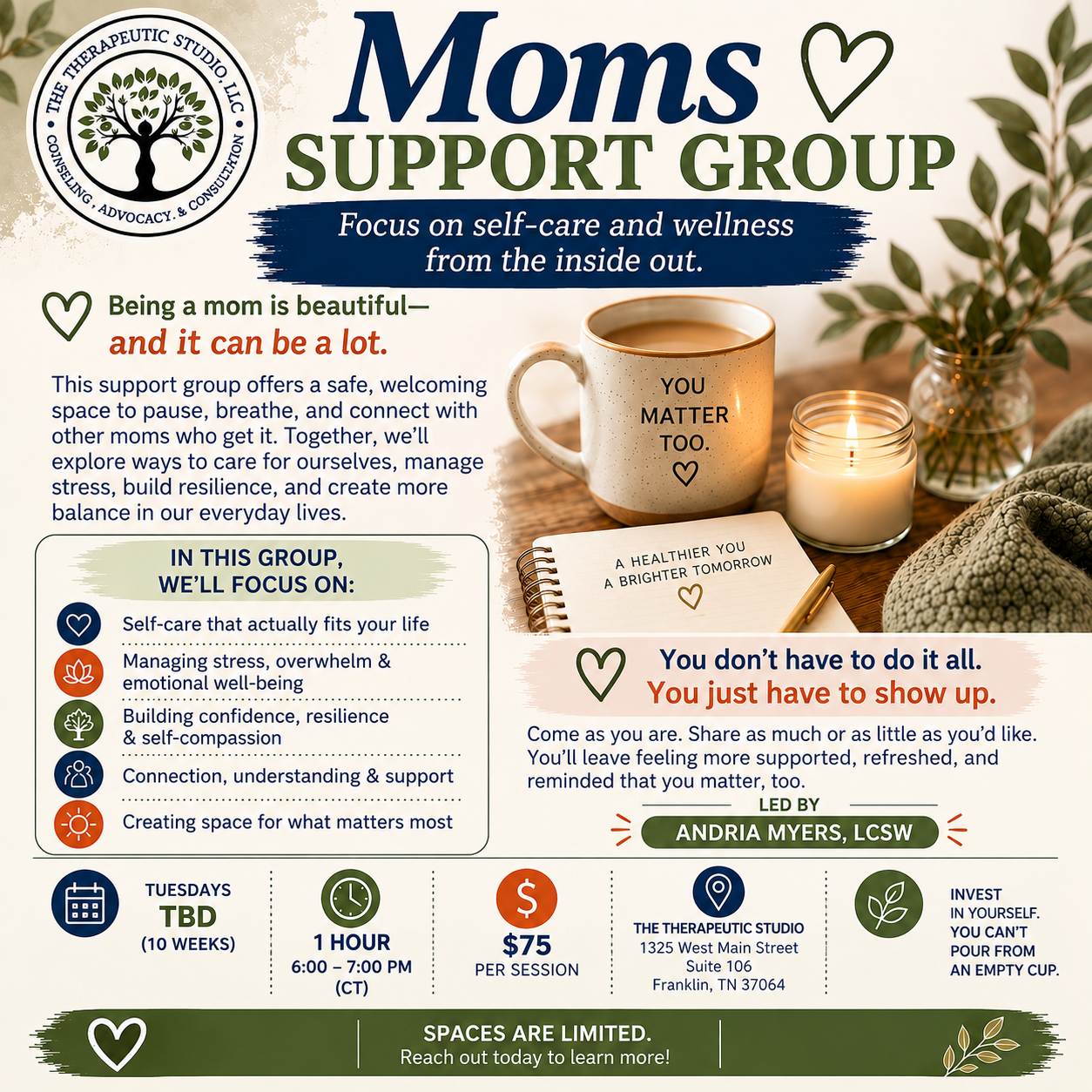
Healing happens in community.
This weekly women’s support group is designed to create a safe, supportive space for women to slow down, connect authentically, and tend to the parts of themselves that are often pushed aside in the demands of everyday life.
Together, we will explore themes of emotional wellness, relationships, boundaries, identity, stress, grief, self-compassion, and personal growth. Through meaningful conversation, reflection, creative experiences, and evidence-based therapeutic practices, participants will have opportunities to deepen self-awareness while also experiencing the healing power of being known and supported by others.
This group may incorporate approaches such as CBT, DBT, mindfulness, somatic and nervous-system regulation strategies, narrative work, and other evidence-based practices to support emotional health and resilience.
Our hope is to create a space where women can:
Build genuine connection and community
Feel seen, heard, and supported
Develop healthier coping and regulation skills
Explore boundaries, relationships, and personal needs
Increase self-awareness and self-compassion
Process life transitions, stress, grief, and emotional overwhelm
Grow in confidence and emotional resilience
Experience healing alongside other women
You do not have to have everything figured out before you come. This is a space to show up as you are, connect with others, and make room for healing, growth, and restoration.
Tuesdays | The Therapeutic Studio
Social Skills Group
Social skills are about so much more than knowing what to say.
Our Elementary Social Skills Group is designed to help kids build the skills they need to navigate everyday life with greater confidence and connection.
Led by Summer Yanosko, BCBA, this 10-week group brings together evidence-based ABA practices with practical sensory integration—in a way that feels natural, supportive, and relevant to real life.
We’ll work on skills like:
• Executive functioning — flexibility, planning, transitions, problem-solving, and managing everyday demands
• Social skills — conversation, friendship, cooperation, perspective-taking, and navigating social situations
• Emotional & behavioral regulation — noticing what’s happening internally and building practical strategies for responding
• Sensory awareness — understanding sensory needs and incorporating tools that support participation, regulation, and connection
This is ABA our way: practical, relationship-centered, neurodiversity-affirming, and focused on helping children develop skills they can actually use beyond the group.
Wednesdays | 5:00–6:30 PM
Beginning September 9 | 10 weeks
$100 per session
The Therapeutic Studio — Thompson’s Station
Build skills. Make connections. Grow together.